
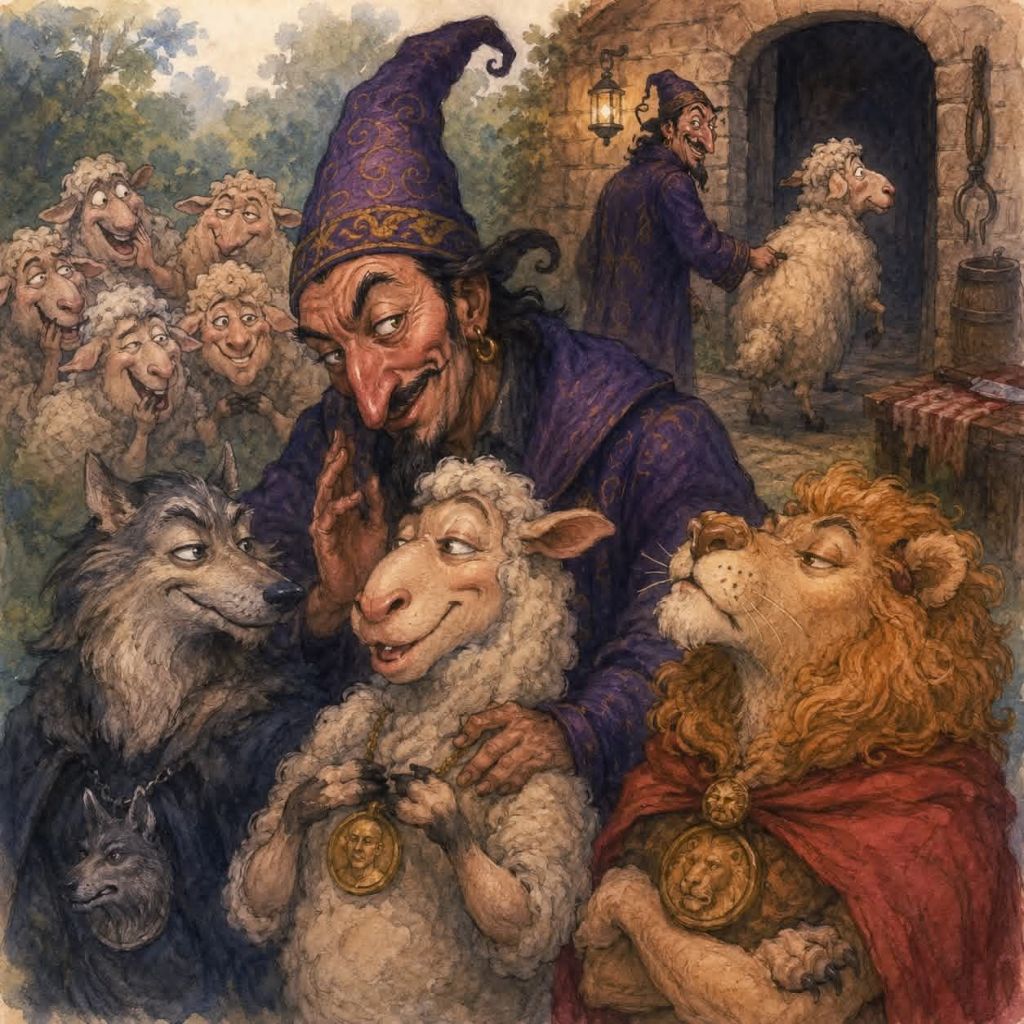
Long ago, in a clearing deep within a vast forest, there lived a magician who owned a huge flock of sheep.
Every day, he slaughtered one of them for food.
But managing the flock was exhausting. The sheep constantly scattered into the woods, forcing the magician to spend hours chasing one down while trying to gather the others back together. And whenever a sheep sensed it was about to be killed, it would panic and struggle desperately, its terrified cries frightening the rest of the flock.
Eventually, the magician came up with a clever solution.
One by one, he spoke privately to each sheep and planted a different idea into its mind.
To the first sheep, he whispered:
“You are not a sheep at all. You’re just like me — a human being. I only kill sheep, and since you are human, you have nothing to fear. In fact, you are my closest friend.”
To another, he said:
“Why do you run from me like the others? You are a lioness — strong and fearless. I only slaughter sheep. You are above them.”
To a third, he murmured:
“You are no sheep. You are a wolf, and I respect wolves. I may continue killing sheep every day, but a wolf — especially my trusted friend — has nothing to worry about.”
And so he continued, speaking separately to every sheep in the flock. To each one, he gave a special identity. Each was convinced it was different from the others — superior, unique, safe.
After those conversations, everything changed.
The sheep stopped running into the forest.
They grazed peacefully and no longer feared the magician.
Whenever he killed another sheep, the others simply thought:
“Well, another sheep is gone. But I’m not a sheep. I’m a lion. A wolf. A human. The magician’s trusted friend. I have nothing to fear.”
Even the sheep chosen for slaughter stopped resisting.
The magician would simply walk up to one and say warmly:
“My dear friend, we haven’t talked in a while. Come with me — I need your advice about the flock.”
Proud of being considered special, the sheep would gladly follow him into the yard. There, the magician would casually ask questions about the others, and the sheep would happily tell him everything it knew.
Then the magician would kill it.
The death came so suddenly that the sheep never even had time to understand what had happened.
The magician was delighted with his strategy.
By convincing each sheep that it was exceptional, he had raised their self-esteem so effectively that they stopped thinking about death altogether. They became calmer, less anxious, and more obedient. They peacefully ate grass and enjoyed their lives — which, according to the magician, even made their meat taste better.
For many years, he ruled over the enormous flock with ease.
And the most remarkable part was this:
The other sheep eventually began helping him.
Whenever one particularly intelligent sheep started questioning what was really happening, the others — the “lions,” the “wolves,” the “humans,” the magician’s “special friends” — would quickly report the suspicious behavior.
And the very next day, the magician would happily eat that sheep too.
— Inspired by the parable attributed to George Gurdjieff
 pastorwardclinton