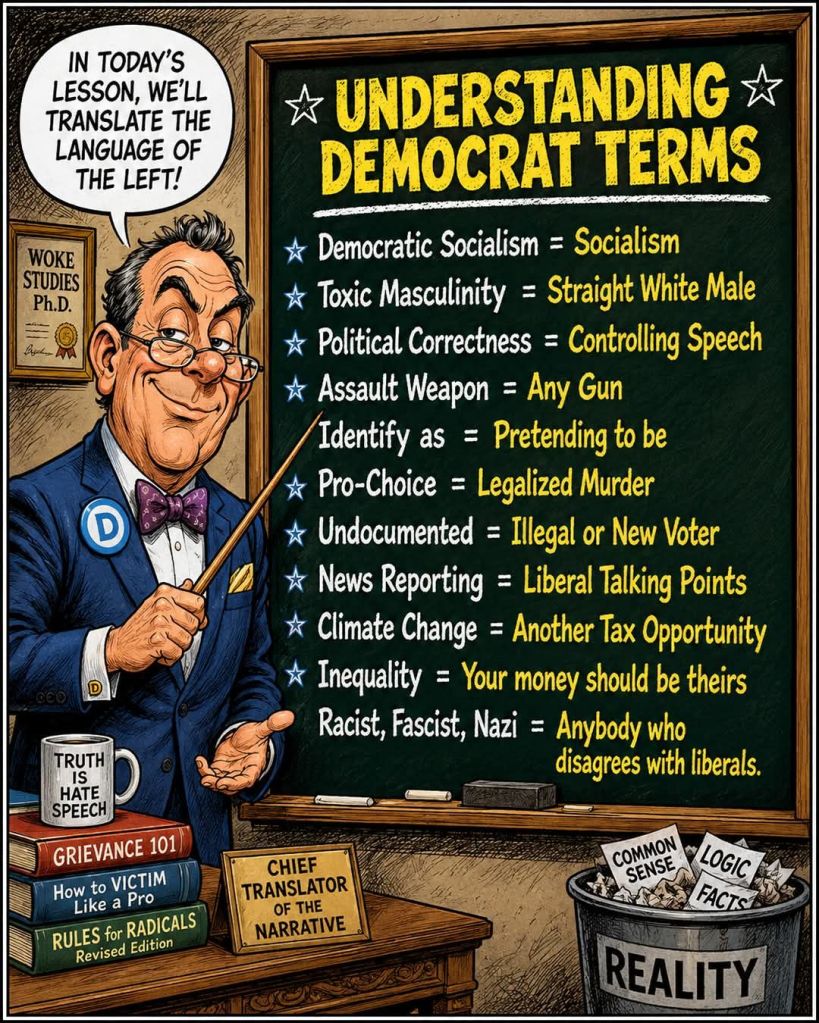
More or less inflammatory, reactionary, hysterical rhetoric of that party. They don’t think things through but react and with emotions. Then when those democrat polices don’t work they prefer to blame other people who had nothing to do with the problems they, the Democrats, created because their, the Democrats, real goal is the usurpation of power
God bless President Donald Trump and his administration for their attempts to promote peace and prosperity.
Iran is almost as trustworthy as gas station sushi and the Democrats? Maybe a little less due to the amount of fraud they’ve been committing and which we are finally learning about.
For years, Democrats and their left-wing allies have acted as if basic economics can be bullied into submission with a slogan, a protest sign, and a government mandate.
They demanded higher wages for entry-level fast food jobs, not because every franchise owner suddenly had extra money lying around, but because it sounded good politically.
And that is always the problem.
It sounds compassionate. It sounds fair. It sounds like standing up for the little guy.
Then reality shows up.
A few years ago, the big rallying cry was the $15 minimum wage. Democrats treated it like some magical solution that would lift everyone up with no downside, no trade-offs, and no consequences.
Then the kiosks arrived.
Now, as the push gets even more aggressive, franchise owners and fast food chains are doing exactly what any rational business would do when labor costs are pushed beyond what the business model can absorb.
They are replacing people with machines.
Not because they are evil. Not because they hate workers. Because they have to survive.
A self-service kiosk does not call in sick. A robot arm does not demand overtime. An ordering screen does not trigger payroll taxes, benefits, scheduling headaches, or lawsuits.
That is the part the left never wants to talk about.
When politicians force costs higher, businesses adapt. Sometimes they raise prices. Sometimes they cut hours. Sometimes they close locations. And sometimes, they automate the very jobs Democrats claimed they were trying to protect.
The sad irony is that the people cheering the loudest for these policies are often the same people hurt first when the entry-level ladder gets pulled away.
Maybe leftists should think things through before taking action that makes their own lives worse.
Good intentions do not repeal economics. They just make the consequences more expensive.
After all, folks:
“Unfortunately, the real minimum wage is always zero, regardless of the laws, and that is the wage that many workers receive in the wake of the creation or escalation of a government-mandated minimum wage, because they lose their jobs or fail to find jobs when they enter the labor force. Making it illegal to pay less than a given amount does not make a worker’s productivity worth that amount—and, if it is not, that worker is unlikely to be employed.” ― Thomas Sowell, Basic Economics: A Citizen’s Guide to the Economy
Long ago, in a clearing deep within a vast forest, there lived a magician who owned a huge flock of sheep.
Every day, he slaughtered one of them for food.
But managing the flock was exhausting. The sheep constantly scattered into the woods, forcing the magician to spend hours chasing one down while trying to gather the others back together. And whenever a sheep sensed it was about to be killed, it would panic and struggle desperately, its terrified cries frightening the rest of the flock.
Eventually, the magician came up with a clever solution.
One by one, he spoke privately to each sheep and planted a different idea into its mind.
To the first sheep, he whispered:
“You are not a sheep at all. You’re just like me — a human being. I only kill sheep, and since you are human, you have nothing to fear. In fact, you are my closest friend.”
To another, he said:
“Why do you run from me like the others? You are a lioness — strong and fearless. I only slaughter sheep. You are above them.”
To a third, he murmured:
“You are no sheep. You are a wolf, and I respect wolves. I may continue killing sheep every day, but a wolf — especially my trusted friend — has nothing to worry about.”
And so he continued, speaking separately to every sheep in the flock. To each one, he gave a special identity. Each was convinced it was different from the others — superior, unique, safe.
After those conversations, everything changed.
The sheep stopped running into the forest.
They grazed peacefully and no longer feared the magician.
Whenever he killed another sheep, the others simply thought:
“Well, another sheep is gone. But I’m not a sheep. I’m a lion. A wolf. A human. The magician’s trusted friend. I have nothing to fear.”
Even the sheep chosen for slaughter stopped resisting.
The magician would simply walk up to one and say warmly:
“My dear friend, we haven’t talked in a while. Come with me — I need your advice about the flock.”
Proud of being considered special, the sheep would gladly follow him into the yard. There, the magician would casually ask questions about the others, and the sheep would happily tell him everything it knew.
Then the magician would kill it.
The death came so suddenly that the sheep never even had time to understand what had happened.
The magician was delighted with his strategy.
By convincing each sheep that it was exceptional, he had raised their self-esteem so effectively that they stopped thinking about death altogether. They became calmer, less anxious, and more obedient. They peacefully ate grass and enjoyed their lives — which, according to the magician, even made their meat taste better.
For many years, he ruled over the enormous flock with ease.
And the most remarkable part was this:
The other sheep eventually began helping him.
Whenever one particularly intelligent sheep started questioning what was really happening, the others — the “lions,” the “wolves,” the “humans,” the magician’s “special friends” — would quickly report the suspicious behavior.
And the very next day, the magician would happily eat that sheep too.
— Inspired by the parable attributed to George Gurdjieff
Dear Hakeem: Although you may not be the best choice for U.S, Minority Leader, we understand that the Islamic Republic of Iran will soon be looking to replace several leaders. Your experience in propaganda, outsized claims, and threats makes you uniquely qualified. Please apply.