What was your first ever videogame?
PONG, yes I am that old.
In some ways it doesn’t seem like that long ago and in other ways it feels like an almost disturbingly long time ago.

What was your first ever videogame?
PONG, yes I am that old.
In some ways it doesn’t seem like that long ago and in other ways it feels like an almost disturbingly long time ago.
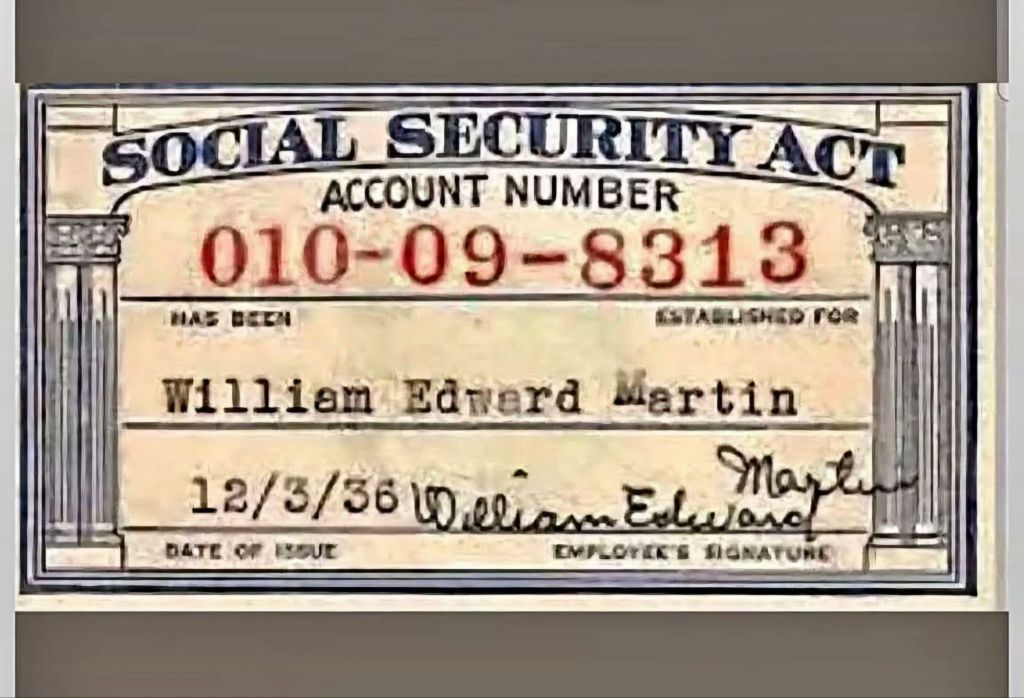
HISTORY LESSON ON YOUR SOCIAL SECURITY CARD:
Just in case some of you young whippersnappers (& some older ones) didn’t know this. It’s easy to check out, if you don’t believe it. Be sure and show it to your family and friends. They need a little history lesson on what’s what and it doesn’t matter whether you are Democrat or Republican. Facts are FACTS.
Up until the 1980’s, Social Security cards expressly stated the number and card were not to be used for identification purposes.
Since nearly everyone in the United States now has a number, it became convenient to use it anyway and the “NOT FOR IDENTIFICATION” message was removed.
Franklin Roosevelt, a Democrat, introduced the Social Security (FICA) Program. His promises are in black, with updates in brackets.
1.) That participation in the Program would be completely voluntary [No longer voluntary],
2.) That the participants would only have to pay 1% of the first $1,400 of their annual Incomes into the Program [Now 7.65% on the first $90,000, and 15% on the first $90,000 if you’re self-employed],
3.) That the money the participants elected to put into the Program would be deductible from their income for tax purposes each year [No longer tax deductible],
4.) That the money the participants put into the independent ‘Trust Fund’ rather than into the general operating fund, and therefore, would only be used to fund the Social Security Retirement Program, and no other Government program [Under Johnson the money was moved to the General Fund and spent], and
5.) That the annuity payments to the retirees would never be taxed as income [Under Clinton & Gore up to 85% of your Social Security can be taxed].
Since many of us have paid into FICA for years and are now receiving a Social Security check every month — and then finding that we are getting taxed on 85% of the money we paid to the Federal government to ‘put away’ — you may be interested in the following:
Q: Which Political Party took Social Security from the independent ‘Trust Fund’ and put it into the general fund so that Congress could spend it?
A: It was Lyndon Johnson and the democratically controlled House and Senate.
Q: Which Political Party eliminated the income tax deduction for Social Security (FICA) withholding?
A: The Democratic Party.
Q: Which Political Party started taxing Social Security annuities?
A: The Democratic Party, with Al Gore casting the ‘tie-breaking’ deciding vote as President of the Senate, while he was Vice President of the US
AND MY FAVORITE:
Q: Which Political Party decided to start giving annuity payments to immigrants?
A: That’s right! Jimmy Carter and the Democratic Party. Immigrants moved into this country, and at age 65, began to receive Social Security payments! The Democratic Party gave these payments to them, even though they never paid a dime into it!
Now, after violating the original contract (FICA), the Democrats turn around and tell you that the Republicans want to take your Social Security away!
And the worst part about it is uninformed citizens believe it! If enough people receive this, maybe a seed of awareness will be planted and maybe changes will evolve. Maybe not, though. Some Democrats are awfully sure of what isn’t so — but it’s worth a try.


Iran has been a designated State Sponsor of Terrorism since Jan 19, 1984. That’s 42 years. When a regime trains kids to chant “Death to America,” believe it the first time.
Iran is a country with vast resources. It was at one time a prosperous nation. But this Iranian regime cares only about exporting Islam and destroying all other beliefs and people. They want nuclear weapons as the key to the ultimate power. Thank God for Donald Trump.
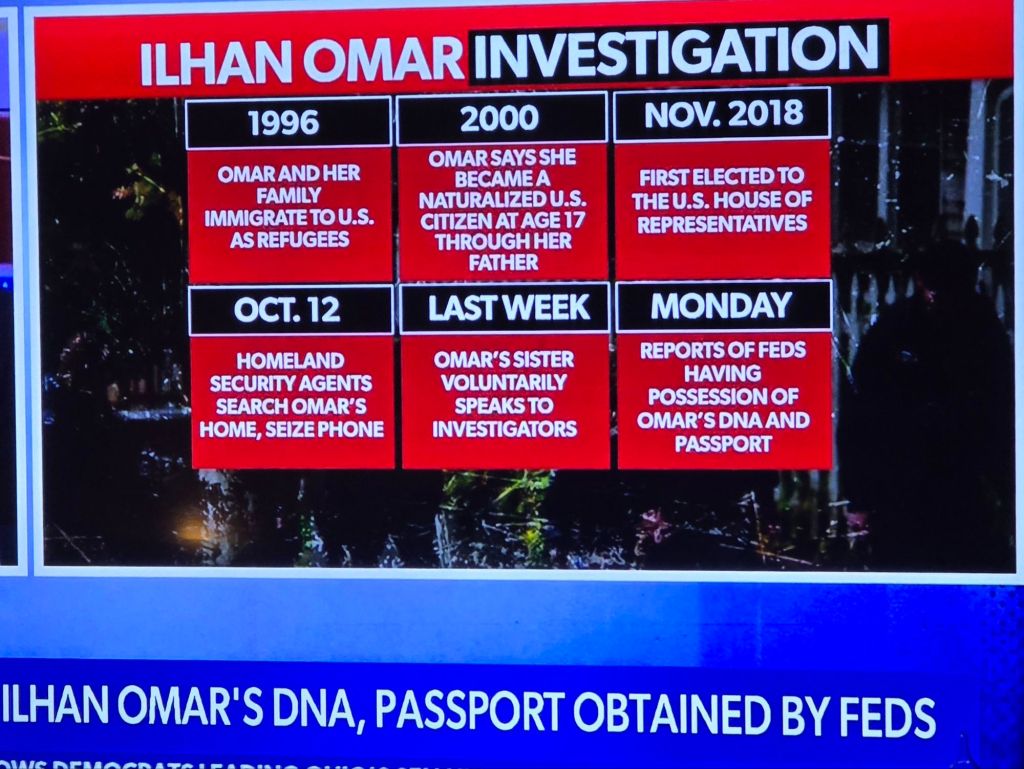
Now she’s whining after she had challenged them to investigate her, and they did.

Remembering what she said about 9-11.
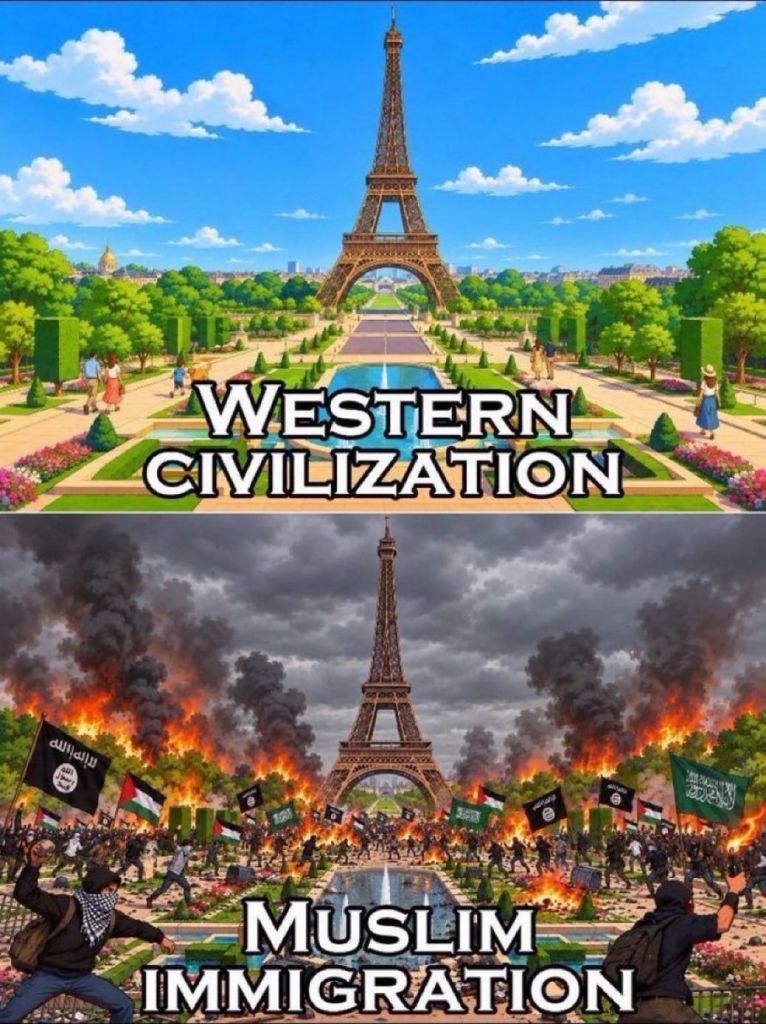
Wake up before it’s too late.

🚨This is a MUST READ: it’s a post from a French Citizen: Brivael Le Pogam, this is the best description of what has occurred in France I have seen, read his words:
Le Pogam: “To every American, and to everyone watching France burn from abroad:
Do not blame the French people for this.
We never asked for it. We never voted for it. And the one time we were clearly asked, we said no.
Here are the numbers your media won’t show you.
70% of the French say there are too many immigrants in France today.
79% want a tougher immigration policy.
77% disapprove of the government’s record on immigration.
83% want foreign criminals and long-term unemployed foreigners sent home.
And no, it’s not just the old. 69% of French 18 to 24 year olds support suspending legal immigration for three years.
This is not a fringe. This is the French people.
In 2005, we were asked if we wanted the European Constitution. 55% voted no. Three years later, our politicians passed the same text under another name, through parliament, without ever asking us again.
That is modern France in one sentence. The people say no. The elites do it anyway.
So who is responsible? The politicians who lied to us. A class of leaders formed in the same schools, the same forums, the same networks, loyal to each other before they are loyal to their nations.
In 2017, at Harvard, Klaus Schwab, founder of the World Economic Forum, bragged about his Young Global Leaders program in four words: “We penetrate the cabinets.” He added that it was true in France. Emmanuel Macron was one of his Young Global Leaders.
It’s the same project in Brussels with Ursula von der Leyen and in Paris with Macron. Borders treated as an obstacle. Nations treated as relics. The people treated as a problem to be managed.
What you are watching in France is not the French people failing. It is the end of the globalist project, an abject, quasi-communist dream of a world run by unelected planners. It is collapsing everywhere in Europe at once, and the West has to cut this cancer out before it takes the rest of the body with it.
The peoples of Europe don’t want this. They never did.
So when you see our town halls burning, don’t say “the French chose this.”
The French never chose this.
They were forced into it.
If you’re French and you agree, repost this so the world hears it from us.
If you’re American, look at us carefully. Then choose differently on November 3rd.”
Hope that wakes you up…
Vote RED 🇺🇸
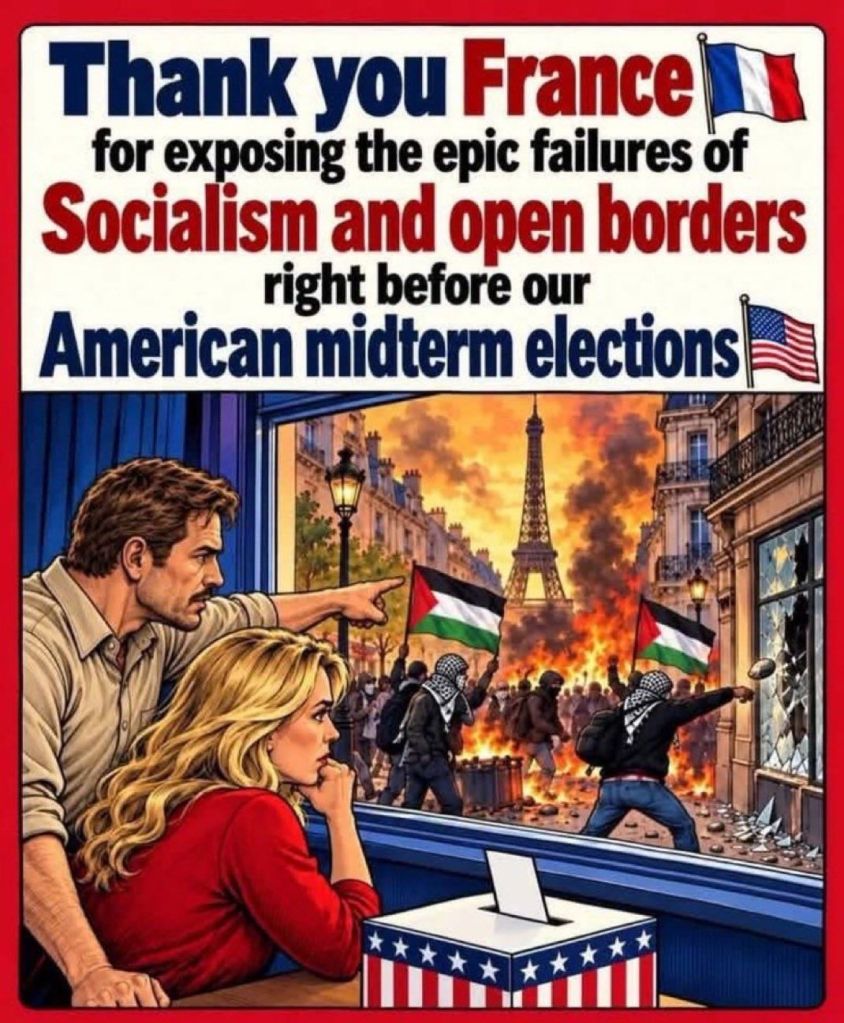
Islamists and Marxists are strange and temporary bed fellows.
Their common enemy: western democracies, Jews and Christians.
The same groups causing mayhem in Europe are already in the US.
Democrats need to import more migrants and crush the 2nd Amendment for their revolution.

