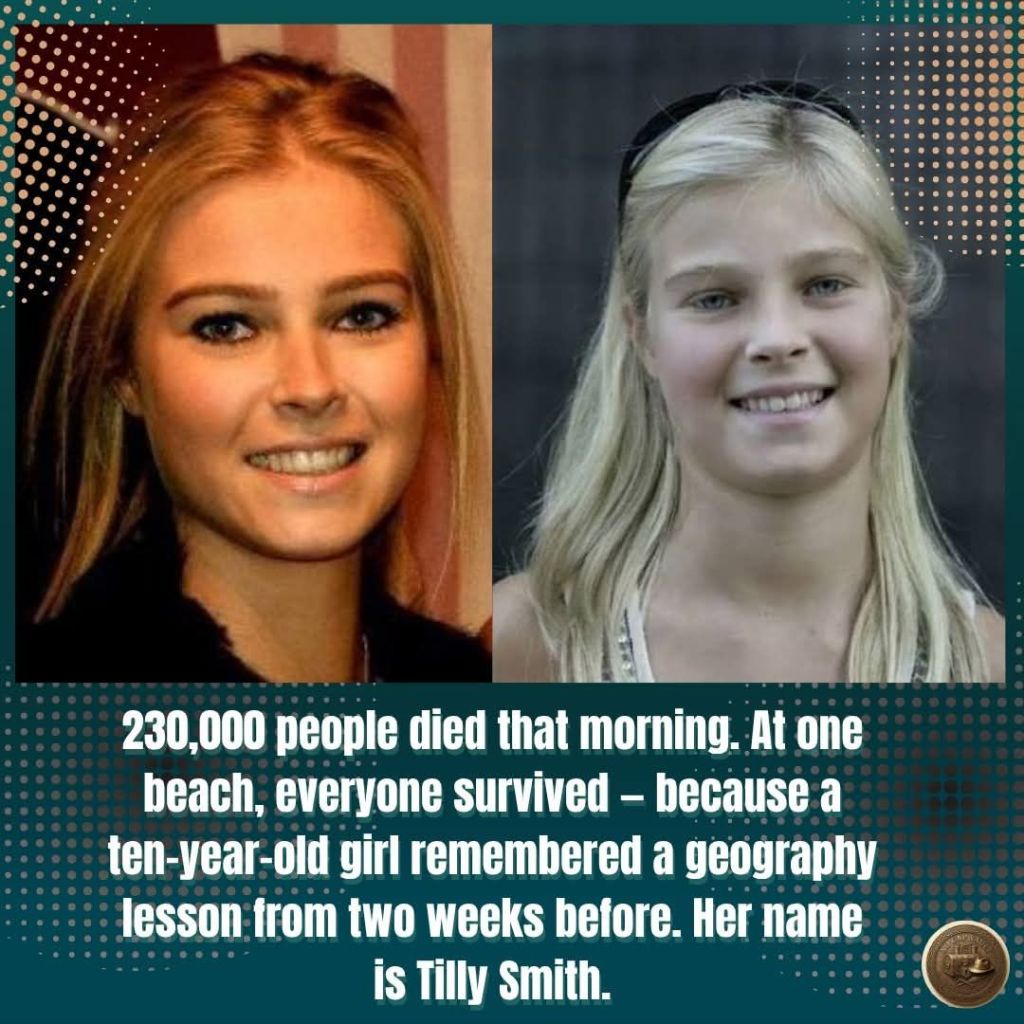
230,000 people died that morning. At one beach in Thailand, everyone survived — because a ten-year-old girl had paid attention in geography class two weeks earlier.
The morning of December 26, 2004, arrived perfect and calm on Mai Khao Beach in Phuket, Thailand.
Families were scattered across the sand. Children built castles near the waterline. Parents relaxed in beach chairs under a cloudless sky. For ten-year-old Tilly Smith from Surrey, England, this Christmas holiday felt magical — her first major overseas adventure, half a world from home, with her parents Colin and Penny and her younger sister.
Tilly wandered near the water’s edge, enjoying the warmth.
Then she noticed something wrong.
The ocean wasn’t behaving normally. Waves weren’t rolling in and retreating the way they should. Instead, water surged forward repeatedly, creeping higher up the beach with each pulse. The sea’s surface had turned frothy — bubbling and fizzing like carbonated water, strange and wrong in a way that most people would have dismissed as an unusual tide pattern and gone back to their morning.
Tilly felt her heart start racing.
She had seen this before.
Not in person. In a classroom.
Two weeks earlier, at Danes Hill School in Surrey, geography teacher Andrew Kearney had taught his class of ten-year-olds about tsunamis. He showed video footage of the devastating 1946 tsunami triggered by an Aleutian Islands earthquake — the destruction, the scale, the power of water moving in ways it was not supposed to move. But the most important part of the lesson wasn’t the footage of the aftermath.
It was the warning signs.
Tsunamis give clues before they arrive, Mr. Kearney explained. Sometimes the ocean pulls far back from shore. Sometimes it behaves erratically — surging strangely, pulling in ways that defy the normal rhythm of waves. The water might become foamy or bubbly as pressure builds underneath the surface. If you ever see the sea acting strangely, he told them, get away from the beach immediately.
Tilly had listened carefully. She had absorbed every detail.
Standing on Mai Khao Beach, watching the bubbling, surging water creep up the sand, her stomach dropped. The unusual waves. The frothy surface. The wrong rhythm. Everything matched what Mr. Kearney had described.
She ran to her parents.
“We need to get off the beach,” she said.
Her father looked confused. Around them, hundreds of tourists continued enjoying the peaceful morning. The sky was clear. No wave was visible on the horizon. Nothing looked dangerous.
“The water’s bubbling,” Tilly said. “It’s moving wrong.” She used the word she had learned in that Surrey classroom two weeks before. “Tsunami.”
Her parents hesitated — not because they doubted her, but because nothing around them suggested danger. The morning was still beautiful. Everyone else was calm.
But Tilly wasn’t guessing. She wasn’t frightened by something she didn’t understand. She was frightened because she understood exactly.
She started shouting. There’s going to be a tsunami. We have to leave now.
Her parents saw something in her face they had not seen before — absolute certainty combined with terror that had a specific shape, the terror of someone who recognizes what they are looking at. Colin Smith made a decision in a split second.
He chose to trust his daughter.
Nearby, a Japanese tourist heard the commotion. When he heard the word tsunami, something clicked — he had heard news that morning about a massive earthquake near Sumatra, Indonesia. Suddenly a ten-year-old girl’s warning didn’t sound like childish fear.
It sounded plausible. It sounded urgent.
The tourist helped alert hotel staff. Within minutes, resort employees were clearing the beach — urging tourists toward higher ground, toward the buildings, away from the water. Some people looked confused. Some laughed nervously. But many listened, and the movement started, slowly at first and then faster, people abandoning the sand and heading inland.
Penny Smith stayed behind briefly, helping staff warn stragglers, encouraging people to move quickly.
The beach emptied.
Then the sound came. Distant at first — like thunder rolling in from the ocean. But it grew louder and closer, a deep roaring that seemed to come from everywhere at once, that shook the air before anything was visible. Penny ran for the hotel stairs as the water began rising behind her.
The wave struck Mai Khao Beach at nearly thirty feet high.
Water exploded onto the shore with a force that snapped palm trees, obliterated beach furniture, and tore across the coastline like a moving wall that destroyed everything in its path.
The beach was empty.
Everyone had already gone.
Across the Indian Ocean that morning, the 2004 Indian Ocean tsunami — triggered by a 9.1 magnitude earthquake off the coast of Sumatra — was killing people on a scale that would take weeks to fully comprehend. Waves traveled thousands of miles. Entire villages disappeared. Cities flooded in minutes. More than 230,000 people died across fourteen countries — Indonesia, Sri Lanka, India, Thailand, and beyond — in one of the deadliest natural disasters in recorded human history.
At Mai Khao Beach in Phuket, despite the massive wave that demolished the shoreline, not a single person died.
Over a hundred tourists had evacuated in time.
Because a ten-year-old girl had paid attention in geography class two weeks before Christmas.
In the days that followed, as the scale of the disaster became clear and the world searched for stories of survival inside the catastrophic loss, Tilly’s story traveled everywhere. She appeared on Good Morning America. Journalists flew to Surrey to speak with Andrew Kearney, the geography teacher whose lesson had echoed across half the world. The story was translated and retold in dozens of languages — a small, specific act of knowledge passing from a teacher to a student and then outward into a moment of genuine crisis, saving everyone it reached.
Mr. Kearney, when asked what he thought about what had happened, said what teachers rarely get to hear confirmed so directly: the lesson had mattered. The information he had considered important enough to teach had found its way to exactly the moment it was needed.
Tilly Smith was asked repeatedly in interviews how she had known what to do, what she had felt standing on that beach with the water behaving wrongly around her.
She said she had remembered what her teacher taught her.
She had seen the signs. She had recognized them. And she had understood — in the way that children sometimes understand things with a clarity that adults complicate — that recognizing danger and doing nothing about it was not an option.
230,000 people died that morning across the Indian Ocean.
At one beach in Thailand, everyone walked away.
Because two weeks before Christmas, in a classroom in Surrey, a teacher taught a lesson — and one of his students listened.
For 10 years, you have knowingly, willfully and relentlessly peddled the lie that Donald Trump is a fascist, Nazi, tyrant, dictator, king, Stalin/Mao/Hitler-like racist, sexist, anti-immigrant white supremacist—while refusing to give him credit for a single achievement.
With a straight face—just because of typical political differences between Republicans and Democrats—you’ve called Trump and his supporters political extremists who want to destroy our democracy, return America to slavery and Jim Crow, and “take away” women’s civil rights.
So why are you surprised that your baseless, sick, rabid and reckless daily attacks on Trump have produced a horde of young, angry, clueless socialist/Marxist/communist “warriors” like Hasan Piker—people you cannot control and who don’t respect you—because they believe you haven’t fought hard enough against the existential threat you’ve spent a decade bullshitting them into believing Trump represents?!
Former Islamic extremist says the goal of Muslims and jihadists is to make America a Muslim county
Imam Mohammad Tawhidi says Muslims are uniting with Democrats to use them to make that happen
“When I was an extremist, Islamist, fundamentalist, I would only vote left — I saw them as very stupid. I would fear the conservatives because they come with principle”
“What is the fundamentalist and jihadi agenda for America?”
“The future of America has to be Muslim”
When you have so many prominent Muslims coming out and saying the goal is to make America an Islamic country, at some point you have to believe them
We have to stop this. We need mass deportations
We need a Great Awakening or we are damned. Don’t be WOKE
When God chooses a leader, the leftists don’t like him. God has demonstrated that He chose Donald J Trump by sparing him, more than once.
If you’re claiming you are a Christian and you’re spending more time talking bad about President Trump than you are spending praying for him, then YOU have and are the problem.
This is so incredibly ridiculous that it almost reads like parody.
The WNBA is the Women’s National Basketball Association. The entire point of the league is that it exists for women. Yet the league is now holding discussions over transgender eligibility while saying there are “no immediate eligibility matters” and denouncing what it calls “bad-faith efforts” around the issue. The league’s own collective bargaining agreement says only women are eligible to play, but reporting on the controversy notes that it does not define the term.
How did women’s professional basketball get to the point where “who is a woman?” requires meetings, task forces and corporate language?
This is also a breathtaking missed opportunity.
Caitlin Clark helped bring enormous attention to the league. The WNBA itself called 2024 a record-setting season, with its highest attendance in 22 years, record television audiences, record merchandise sales, and a single-season attendance record for the Indiana Fever. Clark’s rookie season was at the center of that explosion in interest.
The league had momentum. It had new fans. It had people watching women’s basketball who had never cared before.
Instead of protecting that opportunity, WNBA leadership and some of its coaches have allowed the league to become a progressive political shitshow.
Then came the Sophie Cunningham incident. Chicago’s DiJonai Carrington struck Cunningham in the head and neck, the foul was reviewed and upgraded to a Flagrant 2 because officials found windup, impact and follow-through. Carrington, who is Black, later posted “WHITE PRIVILEGE” and tagged the Fever, although she later said she was not claiming the foul call itself was white privilege.
And somehow the conversation again became about rhetoric, divisiveness and everyone’s feelings instead of simply defending the women who are supposed to be the reason this league exists.
Now former NBA players are making a mockery of the eligibility loophole just to force the question the WNBA should have answered immediately.