Sanctification by Beverly Carradine 5

SANCTIFICATION IS NOT SIMPLY A GREAT BLESSING

To call sanctification simply a great blessing is to rob it of its distinctive qualities.  It is something more than a blessing.  It is a blessing after a different order.  It is a second work wrought in the soul by the Holy Ghost.  Many people have grown merry over the words “second blessing.”  They say that they have gone much further along in the spiritual numerals; that they have advanced into the hundreds and thousands. So has the writer.  But these blessings were all in the regenerated life arising at moments of repentance, prayer, submission, and Christian work, and touching not the life of which we are writing. There is another blessing so peculiar, so distinct, that when a man experiences it, although he had felt ten thousand blessings before, he would ever after call this one the “second blessing.”

I am afraid that the laughter directed at the expression arises from the thoughtlessness of mirth or the failure to recognize the real work and life covered by the words.  It would be well for Methodist preachers, ere they laugh publicly over the expression, to turn to the works of the founder of our Church, Mr. Wesley, and see how frequently and certainly he used it.  In writing to Mrs. Crosby in 1761 he says: “Within five weeks five in our band received the second blessing.” In 1763 he writes: “This morning one found peace and one the second blessing.” To Miss Jane Hilton, in 1774, he writes: “It is exceedingly certain that God did give you the second blessing, properly so called. He delivered you from the roots of bitterness, from inbred sin as well as actual sin.”

Nor is this all.  The expression is not simply Wesleyan, but you might say scriptural; for Paul (in 2 Cor. i. 15) says to the Christians whom he is addressing: “I was minded to come unto you before, that ye might have a second benefit.”  The proper translation of the last word should not be “benefit,” but “grace;” and is so rendered in the marginal reading.

The Greek word is charis, which is translated “grace” one hundred and fifty times in the New Testament. Thus properly translated the verse reads: “I was minded to come unto you before, that ye might have a second grace.” The blessing of sanctification is evidently something more than a great blessing. As for great blessings, all of us have had them who are Christians; but not all have had the second blessing, for a great blessing is not necessarily the second blessing.  My beloved brethren in the ministry, who differ with me, if you come to glorying in great blessings, so will I.  Let me become a fool in such glorying.  Have you had great blessings?  So have I.  Have you had a number? So have I.  And yet not one of these was the second blessing.  Some of them I received in company with ministers who read these lines; some in the presence of various congregations I have served; and still others alone.  And yet not one of these was the second blessing.  Certainly it seems that the writer might be able to speak intelligently and discriminatingly when he humbly but firmly asserts that there is a second blessing for the child of God, altogether different from the multitude of gracious experiences that fill and glorify the Christian life.

The expression “great blessing,” in connection with the work of entire sanctification, is misleading.  The attention of the seeker is thereby directed to an emotion instead of a work and final state. The feeling may be more or less intense, according to temperament, condition, and other things I might mention. It is not a necessary feature of sanctification that a person should be overwhelmed. Some may be; but the majority are not. It is a purifying and filling rather than an overwhelming, a filling of the soul rather than the falling of the body. I grant that some have been perfectly prostrated for moments and minutes; but many have not this torrent-like baptism, and yet are as soundly sanctified as the other class.

Some of whom I have read, and some whom I have known, in receiving the blessing suddenly became conscious of a profound, unearthly, immeasurable calm and sweetness of soul. In the very core and center and heart of the experience is heard the testimony of the Holy Ghost bearing witness to the fact that this is sanctification. Thus was it with Dr. Clarke, Benson, Carvosso, Lovick Pierce, and others. Dr. Pierce said that for minutes he felt that he could live without breathing, so unutterable was the calm in his soul. Dr. Thomas C. Upham, writing about it, says: “I was then redeemed by a mighty power, and filled with the blessing of perfect love. There was no intellectual excitement, no marked joys when I reached this great rock of practical salvation; but I was distinctly conscious when I reached it.”

This is the point I make: that to lay the emphasis upon the emotional feature is misleading. It is as unwise here as it is in conversion to demand certain exalted states as the criterion in such a case. The instant we make an overwhelming rapture the standard experience, that instant we grieve and discourage many, and make it difficult, if not impossible, for them to secure the longed-for blessing. The writer cannot but insist that it is not the great joy felt at the moment that should constitute the after-rejoicing of the sanctified man, but the great work that was done in him at that time. The work is the wonderful thing; the work is the divine accomplishment to be rejoiced over. It may have for its proclaimer a great joy or a great calm or peace; but that is a small matter compared to the work itself.

The joy will subside, in a measure; the peace may have its variations; but the work done in sanctification remains. Glory to God for the work! Earthly conditions and experiences may beat like waves upon you; but, rock-like, the work itself abides, resisting every wave and outliving every storm. People and surroundings may change; failure and disappointment and loss may crowd into the life; but there, enthroned in the heart, is this perfect love to God and man that changes not, an inward calm and rest that never departs, and a faith in God that remains unshaken.

Yes, sanctification is a great blessing; but the greatness is not in the emotions which accompany it, but in the work of sanctification itself. And while the sanctified man cannot but rejoice in the possession of a peace and rest that never leave him, yet his deepest joy is in the constant realization of the work itself; that he is crucified with Christ; that he is dead to the world, and alive to God as never before; that inward sin is dead; that love reigns supreme in the heart, and that Christ abides within in a fullness and with a constancy delightful and amazing.

If God’s people, instead of doubting and denying, would humbly and prayerfully seek for sanctification as they did for conversion, then, in the language of the pastoral address of the General Conference of 1832, “our class-meeting and love-feasts would be cheered by the relation of the experiences of the higher character, as they now are with those which tell of justification and the new birth.” – Beverly Carradine

Chapter Four      Chapter Six          My books on Amazon

–Pastor Ward Clinton

Sanctification by Beverly Carradine4

SANCTIFICATION IS NOT A RECOVERY FROM BACKSLIDING

The supposition of many who have not realized this grace in the soul is that it is the recovery of the first love, or return from a more or less backslidden course. The idea is urged again and again, by different writers who are opposed to sanctification, that the professed possessors of the blessing had really drifted through unfaithfulness into a condition of darkness, fear, and even sin; and in looking for a second cleansing or sanctification have mistaken their recovery, or restoration of religious joy, for the blessing of sanctification; and, thus deluded, proclaim the fact that they have received the second blessing, when they have only been recovered from the life and course of a backslider.

This is certainly very different from the teaching of a famous little volume, called “Christian Perfection,” written by one of the most eminently pious men that ever lived, which says that entire sanctification is preceded by a gradual mortification of sin and ardent aspirations after holiness; in a word, by conditions and experiences the opposite of backsliding.  According to this definition of sanctification, that it is nothing but a recovery from backsliding, we are necessarily led to infer that the Thessalonians, whom Paul so highly commended in his Epistle, saying that they were “ensamples” through their labor of love, patience of hope, and joy in the Holy Ghost, that they were really a set of backsliders. And when he wrote, “and the very God of peace sanctify you wholly,” he meant that he hoped the God of peace would recover them from their present backslidden condition. Truly this definition and explanation of entire sanctification, or the second blessing, as given by the doubters of the work, is enough to make Wesley turn over in his grave, and to cause the admirers of Fletcher and Carvosso and Clarke and Benson and McKendree to blush for those consecrated men of God. So, according to this explanation, these holy men were backsliders. Who is ready to credit this? Who, after reading their lives and their own statements and descriptions of the blessing of sanctification, can believe such a thing of them? Read the “Life of Fletcher,” and see how the definition fails to agree with the facts. Open the “Life of Carvosso,” and see how, after his conversion, he pressed steadily on, living in prayer, and never resting until he obtained the blessing of sanctification.

Now we turn to Bishop McKendree he is giving his experience: “Not long after my conversion Mr. Gibson preached a sermon on sanctification, and I felt its weight. When Mr. Easter came he enforced the same doctrine. This led me more minutely to examine the emotions of my heart. I found remaining corruption, embraced the doctrine of sanctification, and diligently sought the blessing it holds forth. The more I sought it, the more I felt the need of it, and the more important did that blessing appear.  In its pursuit my soul grew in grace.” Then he goes on to describe when and how the blessing of sanctification came upon him. Where does the backsliding come in here? When did he lose God? On the contrary, he tells us that as he sought the blessing his soul grew in grace.

Now let the reader turn to Mr. Wesley’s volume on “Christian Perfection,” and read certain paragraphs on pages 37, 61, and 78, and he will find that the author calls the blessing a total death to sin and an entire renewal in the love and image of God obtained instantaneously, received by faith, and witnessed to by the Holy Ghost. In none of these instances can you find anything favoring the idea of a recovery from backsliding. On the contrary, it is represented as a sudden uplift and deliverance granted a soul that had been previously growing in grace; that it is a second and distinct work done in and for not a backslidden, but a consecrated life.

With great shrinking I mention my own experience in the same breath with such superior and holy men. But God calls upon me to witness here, and by my tongue and pen to protest humbly, but firmly, against this degrading definition of sanctification. God knows that I have not been a backslider. He knows that for over twelve years the rule of my life, rarely broken, has been never to lay my head upon my pillow until I felt a sense of acceptance with him; while every day I have felt his peace and presence in my soul.

Evidently the blessing I received on June 1, of last year, was not a recovery from backsliding.

Chapter Three          Chapter Five          My books on Amazon

–Pastor Ward Clinton

TAGALOG – Talking About God And Living Out Grace

Every Christian is, in all actuality, a theologian.  Imagine how blessed our world could be if every Christian were a good theologian in the distinctly Christian sense.

There is very much a need for “the Church” to again proclaim and live the message of Christian holiness.  Collectively, it have been, for quite some time now, living far below the standard that it has been called to.  The people of God must once again become “salt and light” especially in this hour of spiritual darkness.  Our lives must become “reruns” of the life of The Christ, that is, lives fully surrendered to the Father’s will, cleansed and filled by His Holy Spirit.  Christ-like men and women are very urgently needed at this time, in this hour.

God has always intended for His people to be a holy people.  The Holy Bible is pretty clear about that.  God has designed a plan whereby the heart of His people can be cleansed from all sin.  Some can’t see that because they don’t want to see that fact.

1st Thessalonians 4:7 “For God did not call us to be impure, but to live a holy life.”

God did not call us to imitate a sinful man but to be like, to imitate, the Holy One of God, Jesus The Christ.

1st Corinthians 3:3 “You are still worldly.  For since there is jealousy and quarreling among you, are you not worldly?  Are you not acting like mere men?”  We are called to be imitators of Jesus, the holy one of God, and not like mere sinful men trying to make excuses for being sinful rather than living better lives than that.  We are called to have a better understanding of God and an acceptable walk.  1st Peter 1:13-16

“Therefore prepare your minds for action; be self-controlled; set your pope fully on the grace to be given you when Jesus Christ is revealed.  As obedient children, do not conform to the evil desires you had when you lived in ignorance.  But just as He who called you is holy, so be ye holy in all that you do; for it is written: ‘Be holy, because I am holy.'”

Christians are supposed to stay clean while living in an unclean world;  Jesus did not compromise with the world, He remained holy and sin-free and we are to follow his example — not the devil’s.

1st Thessalonians 5:23-24 And may the God of peace Himself fully sanctify you, and may your whole spirit and soul and body be kept blameless at the coming of our Lord Jesus Christ.  Faithful is the One calling you, who also will perform it.

Walk in the paths of holiness of heart and life, the world secretly longs for us Christ followers to do that.  Sure they may give us grief for it, but if we do not falter, some of them will join us in that walk, the only walk that is acceptable to the one true God, the God of Father Abraham, Isaac, and Jacob.

Then, when we Talk About God And Love Others Graciously – they will see something special and understand.

–Pastor Ward Clinton

Talking About God …continued

Good Theology requires a good perspective.

Three people were visiting and viewing the Grand Canyon – an artist, a pastor, and a cowboy.  As they stood at the edge of that massive abyss, each one offered his personal perspective.  The artist said, “Ah, what a beautiful scene to paint.”  The minister said, “What a wonderful example of the handiwork of God.”  The cowboy mused, “What a terrible place to lose a cow.”

If every Christian were a better theologian the world, instead of sitting on the verge of collapse into chaos, would be a far better place than it is currently.

True theology points to God.  In the summer of 2015, LifeWay Research conducted a survey which revealed that 45% of Americans claim there are many ways to Heaven.  Only 30% of Americans actually have Evangelical beliefs and of them only 70% believe Jesus is the only way of salvation.  The good news is that it does appear that those who believe Jesus is the only way also believe that they have a responsibility to encourage non-Christians to trust Jesus as their Savior.

Featured Image -- 18   Distinctly Christian theology, which the apostle Paul refers to as “sound doctrine” in 2nd Timothy 4:3 is founded upon the belief that God has revealed Himself to us in His Word, The Holy Bible.  Of course good theology is also focused on Messiah, the holy one of God, The Christ.  We read in the Gospel according to John in 5:39 that Jesus declared the Scripture testifies about Him.
Unfortunately, a large portion of Americans are getting their “theology” from Hollywood, television, and other unchristian, even antichristian sources instead of the Holy Bible.  Yes, even Christians have to be careful to avoid getting their theology warped by the wrong sources.

It is by knowing God that we come to love Him, and by loving Him that we come to know Him who first loved us.

Theology is undertaken so that our hearts might respond to God and that our lives might be conformed to His will, not the will of some mere ‘prophet.’  Loving God and loving people are made possible by a correct theological vision of God and the Christian life.

True theology, a correct speaking of the things of God, fuels our devotion to God, the God of Father Abraham, Isaac, and Jacob and our passion for sharing the gospel of the holy one of God, Jesus The Christ.

Every Christian is, in all actuality, a theologian.  Imagine how blessed our world could be if every Christian were a good theologian in the distinctly Christian sense of the term.

–Pastor Ward Clinton

Talking About God

Jesus v Muhammad

I’m a theologian.

Now I don’t know what thoughts just came into your head when you read that.  What I know is that I tend to have a slightly erroneous picture formulate in my own head. (But i’m getting better)

Many of us Christians tend to think of theology as an abstract academic discipline with little bearing on day-to-day Christian life and activity.  Therefore one of the first things we ought to do is to understand what theology is.  Theos (God) logos (word); it means a word about God.

There is Christian theology, Muslim theology and atheist theology as well as a few others.  …Atheist theology?  …Oh yes, some atheists absolutely obsess on the God whom they vehemently deny exists and then they go to great effort, expending lots of energy and time, to try to get rid of the God they claim to not believe in…is that weird or what?

It is no wonder, then, that God calls them what He does.

Muslim theology is based on the Koran while Christian theology is talking and thinking about God in a distinct way based upon the Holy Bible which, even the Koran acknowledges, is the uncorrupted holy book of God.  Sadly, for the followers of Mohammad, most of them don’t seem to be aware of that fact.  That is understandable because of all the confusing contradictions contained in each of the various versions of the Koran.

Every Christian, by definition, knows God, thinks about God, and makes statements about God.  Therefore every Christian is a theologian; some are better at it than others but every child of God is supposed to be a good theologian and that is accomplished by studying and knowing what is actually in the Holy Bible and what is not.  Some, if they are asked to open their Bible to something like 2nd Hezekiah 3:16 will search and search while others will quietly smile.  It is an indicator of the level of theological understanding, not the best indicator, but it is one.

I am an above average theologian but every Christian should be at least at my current level.  I did not get to my current level of theological comprehension without lots of study and help from fellow Christians; however I am far from where I really should be.

If every Christian were a better theologian the world would be a far better place than it currently is.

…to be continued…

–Pastor Ward Clinton

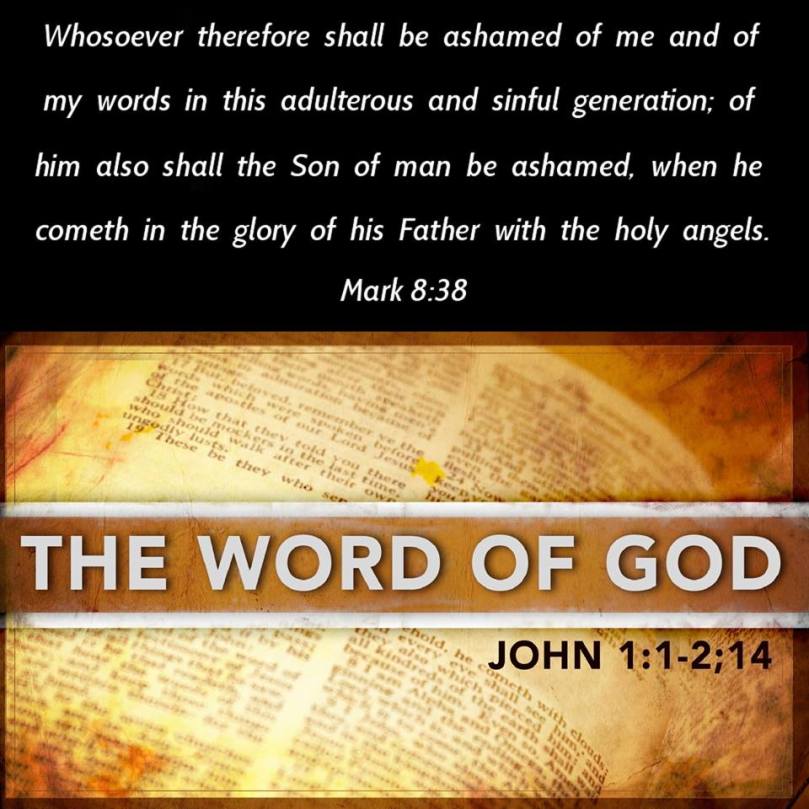
Mark 8:38

Mark 8 38.jpg

“I will keep my religion to myself,” says one; if you will not confess The Christ to men then He will renounce you before, in the presence of, God.

Let it always be remembered, that to be renounced by The Christ is to have Him neither for a savior nor for a mediator.  Thus there is a fate worse than human persecution; to be repudiated, or renounced, by Jesus Himself before the Father.  The “first hearers” of this statement heard, in this statement, a clear declaration from Jesus that He, not God the Father, it the final determiner as to whom will be allowed to enter into and abide in Heaven and who will not.  Rejection by humans is temporary; rejection by Jesus is forever.

Fear of men is a self-interested, self-deluding cowardice; fear of God is a healthy response of awe and obedience.  The latter is positively commended upon throughout the Bible while the former is condemned by God as well as by men everywhere.

–Pastor Ward Clinton

Christian, Be Diligent

Matthew 10:40 [Jesus said:]  He that receiveth you receiveth me, and he that receiveth me receiveth him that sent me.

10:41  He that receiveth a prophet in the name of a prophet shall receive a prophet’s reward; and he that receiveth a righteous man in the name of a righteous man shall receive a righteous man’s reward.

10:42  And whosoever shall give to drink unto one of these little ones a cup of cold water only in the name of a disciple, verily I say unto you, he shall in no wise lose his reward.

What completely different spheres of duty are assigned to the clergy and the laity!  And we are told that he who labors with great earnestness in the work of a clergyman has a reward of peculiar splendor within reach, inasmuch as “They who turn many to righteousness shall shine as the stars for ever and ever.”  But it is evident from this text that the same reward is attainable by others who have never been called to the clergyman’s work.  They who have not been “prophets” may “receive a prophet’s reward,” and if an individual have upheld a clergyman in his arduous and most responsible calling, strengthening him by such assistances as the occasion demands, sustaining him when assailed, cheering him when disheartened, and all out of love for his office, and desire for his success, so that he receives the pastor in the name of a pastor, we may say of such an individual that in God’s sight he takes part in the clergyman’s labors. [and shall be rewarded by his Lord]. – H. Melvill, B.D.

Be blessed, be encouraged, and whatever you do, whatever your line of labor is, do it as though you are doing it for our Lord, Jesus, The Christ — Pastor Ward Clinton

If Jesus were Physically with us today….

“Most people say they have a good relationship with God and would worship Him and adore him if He was here present physically with us. I disagree. I think it is clear they would hate Him and try to destroy Him due to not feeling free to be themselves around Him. Just look how people treat serious Jews and Christians in today’s world.” Robert Simmons January 28, 2016″ – Robert Simmons

The Huffington Post had a writer claiming Christians can view Mohammad as a prophet.  Their writer, Craig Considine, claimed that he is a Christian with deep admiration for Mohammad.  Craig claims that since Moslems recognize Jesus as a prophet then Christians should “Turn the other cheek” and recognize Mohammad as a prophet as well.  Craig claims “Mohammad brought love, peace, and much more to a part of the world that had little of these things.”  Bear with me for a bit, ladies and gentlemen.

Craig claims Mohammad wasn’t racist against blacks and that he had a fierce “anti-racist stance.”  However historical facts do not support Craig’s claims.  Craig may claim to be a Christian but his writing clearly demonstrates otherwise and may actually prove that he is a Moslem practicing taqiyya.  Or perhaps he is conducting hijrah, which is stealth cultural jihad in service of the god of the Koran.  “By their fruit you shall know them.”  Real Christians know and believe that John the baptizer was the last of the prophets because the age of the prophets ended with the arrival of Messiah Jesus, the holy one of God, in this world.

It is strange, to say the least, to suggest that Islam, which began and was based on a vile Christian heresy could have any compatibility with genuine Christianity.  Mohammad’s subtractions, additions, and corruptions of Christianity have always been viewed as perversions, not prophecy.  Furthermore, to claim that Mohammad brought “love & peace” is an incredibly ignorant claim.  Islam is still behaving barbarically today as it has from its very founding by an incredibly sinful man.

The world seems quite comfortable with so-called Christians who compromise the core claims of Christianity and call Jesus a mere prophet rather than the very special holy one of God.  What some may not realize is that that compromise is a denial of Jesus The Christ before men and we have been warned quite clearly as to the consequences that will result.

Pastor Ward Clinton

Wonderful, Counselor,

Wonderful Counselor

–Pastor Ward Clinton