A lot of that listed above is also why I don’t care for the Democrat Party leadership.

A lot of that listed above is also why I don’t care for the Democrat Party leadership.

Why has the mainstream media NEVER told you this? The Democratic Socialists of America recently voted in support of completely DISMANTLING the American Republic and replacing it with a new system.
Their national political committee voted 12 to 11 in support of ABOLISHING the Presidency and the Supreme Court and making everything completely subordinate to Congress. Look at how many of them have run for Congress lately! What are the odds?
Over 51% of the DSA’s governing board members are now self-avowed communists. And they recently passed 120,000 members, making them the largest “socialist” organization in American history. Ten years ago, that number was only 6,000.
The mask is fully off. The radicals are actively infiltrating the Democratic system to execute this blueprint from the inside out. Look at Mamdani and the slate of radicals winning primaries and trying to seize real political power. They are systematically replacing traditional Democrats with radical collectivists who are openly telling you, in their own published platform documents, that they want to dismantle the American Republic and destroy the separation of powers. The facade is gone. This IS the communist blueprint for a silent takeover.
It is a dismantling of our great nation. We must wakeup and turn back to the right, the righteous path. Pastorwardclinton.com
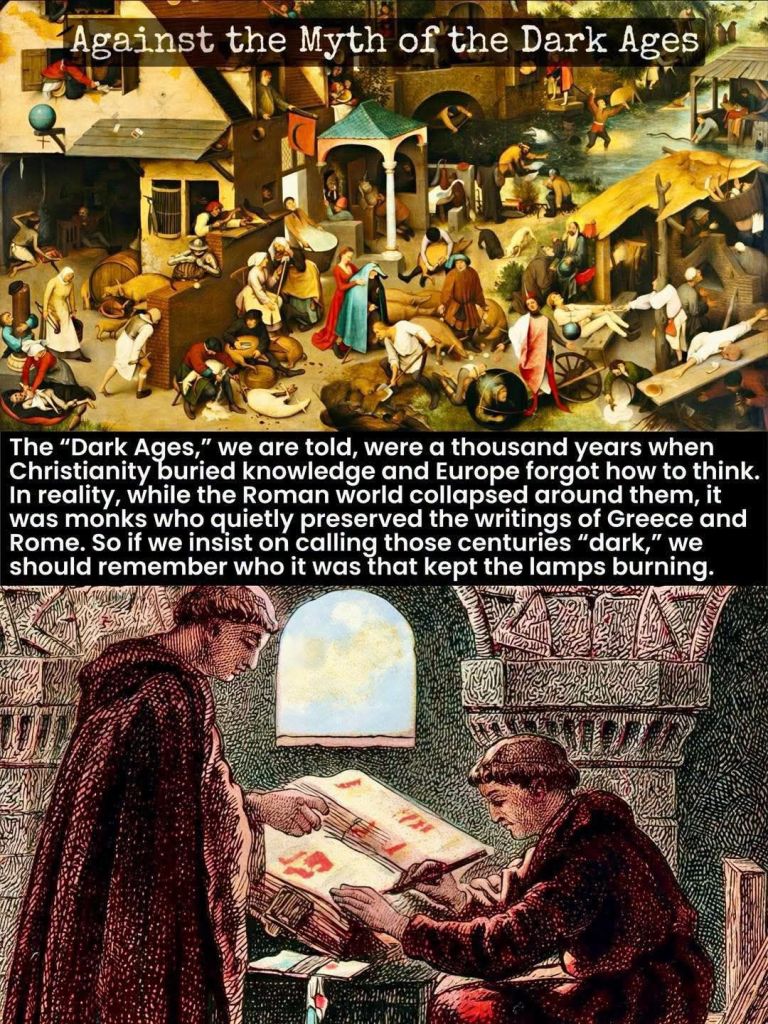
The phrase is repeated so often it has hardened into certainty. The Dark Ages, we are told, began when the Roman Empire collapsed and Christianity smothered the light of classical civilization. Science vanished. Learning died. Europe stumbled blindly through a thousand years of superstition until the Renaissance finally rescued reason from the grip of priests.
It is a tidy story. It is also wrong.
When the Western Roman Empire collapsed in the fifth century, the disaster was not theological—it was civilizational. Cities emptied. Trade routes collapsed. Roads crumbled. Literacy declined. Political authority fractured into a patchwork of Germanic kingdoms that possessed neither the administrative machinery nor the cultural inheritance of Rome.
The darkness that followed did not descend because monks burned books. It descended because the world that produced those books had collapsed.
And yet, in the wreckage of that fallen order, something remarkable happened. In lonely valleys and along forested hillsides, small communities of Christian monks began doing something that no conquering army, no new king, and no collapsing city seemed interested in doing: they preserved the memory of the ancient world.
Inside monastic scriptoria, by candlelight and patient discipline, monks copied manuscripts—line by line, page by page. They copied the Scriptures, of course. But they also copied Virgil, Cicero, Ovid, Livy, and countless other works of classical antiquity. Without those quiet labors, much of what we know about Greece and Rome might simply have vanished.
The men doing this work were not secular humanists ahead of their time. They were Christians. They believed that truth, wherever it appeared, ultimately belonged to God. Preserving learning was not rebellion against faith. It was an act of devotion.
Monasteries became islands of stability in a turbulent world. They cultivated fields, organized communities, and preserved literacy at a moment when most of Europe had forgotten how to read. Their libraries became reservoirs of memory while kingdoms rose and fell around them.
Over time those small islands of learning began to connect. By the eleventh and twelfth centuries a new intellectual revival was underway. Cathedral schools evolved into institutions dedicated entirely to scholarship. These institutions would soon receive a new name—universities.
The University of Bologna, Paris, and Oxford did not emerge in defiance of the Church. They were born inside it. Theology stood beside law, medicine, and philosophy as part of a unified search for truth. Scholars argued fiercely over Aristotle, debated logic, experimented with natural philosophy, and tried to reconcile reason with revelation.
The medieval world was not anti-intellectual. It was intensely intellectual. Figures like Thomas Aquinas, Albertus Magnus, and Roger Bacon wrestled with the newly rediscovered works of Aristotle and the expanding body of knowledge flowing from the Islamic world. They did not treat faith and reason as enemies. They believed both ultimately pointed toward the same reality.
Even the foundations of what would later become modern science were quietly forming during these centuries. Medieval thinkers developed the idea that nature operated according to rational laws because it had been created by a rational God. If the universe was ordered rather than chaotic, then studying it was not impiety—it was a form of worship.
The irony is striking. The very civilization accused of plunging Europe into darkness built the intellectual institutions that would eventually illuminate it.
None of this means the medieval world was idyllic. It was violent, unequal, and often brutal. Wars were frequent. Plagues were devastating. Superstition and ignorance certainly existed. But these were not the unique failings of Christianity. They were the universal conditions of premodern life.
What Christianity provided was something different: continuity.
While political power fractured and empires dissolved, the Church preserved a transnational network of literacy, scholarship, and moral authority that stretched across Europe. Monasteries safeguarded texts. Universities trained scholars. Cathedrals became centers of art, architecture, and education.
The world that later produced the Renaissance did not emerge from a thousand years of darkness. It emerged from a civilization that had spent centuries preserving the light.
History rarely fits into the neat morality plays modern culture prefers. The medieval centuries were neither a golden age nor a pit of ignorance. They were something far more interesting: a long and difficult bridge between the ancient world and the modern one. And if we insist on calling them “dark,” we should remember who it was that kept the lamps burning.

The hatred the left has for President Trump led to this. Democrats like Schumer, AOC, Pelosi, Maxine Waters, and many in the media are responsible for this as well due to all the hatred they’ve spewed towards him.
Biden’s Culpability

Christianity is not a retreating faith. Scripture presents God as a God of order and truth, and it consistently calls His people to uphold both, even when doing so is uncomfortable.
A political party that refuses to enforce its own national laws is not practicing biblical compassion; it is abandoning responsibility.
I don’t know who Abbie Conant is but she posted this cartoon to praise socialism and own the cons. She seems a bit prickly, ending the post with:
“It appears that Facebook manipulated the distribution of the post to include hundreds of people who are not my friends and who have rather ignorant, rightwing views. At any rate, their comments provide an interesting view of the USA and the bizarre narrowness of its political spectrum.”
Being an ignorant right-winger, I felt her statement was invitation to inject a little non-ignorance to the discussion, so I tagged her.
Here goes.
The cartoon is clever, but it rests on an assumption that falls apart the moment you spend thirty seconds thinking about it.
It invites the viewer to look at Paris—Notre-Dame, the Eiffel Tower, the Louvre, the Arc de Triomphe—and conclude that socialism must be responsible because France today has a large socialist influence in its government. That is like pointing at the Golden Gate Bridge and arguing that Medicare built it because both exist at the same time.
Almost everything that makes Paris instantly recognizable predates modern socialism by centuries. Notre-Dame was built by the Catholic Church beginning in the twelfth century. The Louvre began life as a royal fortress under the French monarchy. The Arc de Triomphe was commissioned by Napoleon. The grand boulevards of Paris were carved through the city under Napoleon III. Even the Eiffel Tower—the youngest landmark in the cartoon—was built by Gustave Eiffel’s private engineering company for the 1889 World’s Fair, decades before democratic socialism became a meaningful political force in France.
Socialists did not build Paris. They inherited it.
More importantly, they inherited the wealth that made Paris possible. The city’s monuments, museums, churches, bridges, and boulevards were financed by centuries of commerce, manufacturing, private enterprise, skilled craftsmen, merchants, engineers, architects, religious institutions, and, yes, governments taxing an increasingly productive economy. Whether one admires monarchies or not, the wealth that produced these works was created long before the modern welfare state existed.
This illustrates a common rhetorical sleight of hand. Advocates of socialism frequently point to prosperous Western nations with generous welfare systems as evidence that socialism works, while quietly overlooking the fact that those societies became wealthy before they dramatically expanded redistribution. The prosperity came first. The welfare state came later.
That does not prove that every social program is bad. It does expose the dishonesty of claiming credit for a civilization that others built. There is a profound difference between creating wealth and redistributing wealth that has already been created. The meme intentionally blurs that distinction.
If someone wants to argue that modern France is better because of its social policies, make that argument. But don’t pretend socialism built Notre-Dame, the Eiffel Tower, or the Louvre. History simply will not cooperate.
Paris is not a monument to socialism. It is a monument to nearly a thousand years of religion, private enterprise, engineering, commerce, art, and accumulated civilization. Socialists didn’t build that city any more than Medicare built the Golden Gate Bridge. They simply arrived after it was already standing.


Just a reminder of what she was saying then. A very accurate statement.

A psychiatrist has related that many, if not most, affected “can be traced to an individual’s low self-esteem.
They resent the masculinity, success, and confidence that they themselves can never achieve.”
Of course there is a lot more in that study but the gist of it seems that the “participation trophy recepients” never learned self-responsibility.
U.S. Supreme Court stated in the 1892 case of Church of the Holy Trinity v. United States, written by Justice David Josiah Brewer (143 U.S. 457-458, 465-471, 36 L ed 226): ” This is a religious people.
This is historically true. From the discovery of this continent to the present hour, there is a single voice making this affirmation.
The commission to Christopher Columbus…(recited) that
‘it is hoped that by God’s assistance some of the continents and islands in the ocean will be discovered’…
The first colonial grant made to Sir Walter Raleigh in 1584…and the grant authorizing him to enact statutes for the government of the proposed colony provided
‘that they be not against the true Christian faith’…
The first charter of Virginia, granted by King James I in 1606…commenced the grant in these words:
‘…in propagating of Christian Religion to such People as yet live in Darkness…’
Language of similar import may be found in the subsequent charters of that colony…in 1609 and 1611; and the same is true of the various charters granted to the other colonies.
In language more or less emphatic is the establishment of the Christian religion declared to be one of the purposes of the grant.
The celebratedcompact made by the Pilgrims in theMayflower , 1620, recites:
‘Having undertaken for the Glory of God, and advancement of the Christian faith…a voyage to plant the first colony in the northern parts of Virginia’…
– Pastor Ward Clinton
Happy blogging!