Dark Ages?

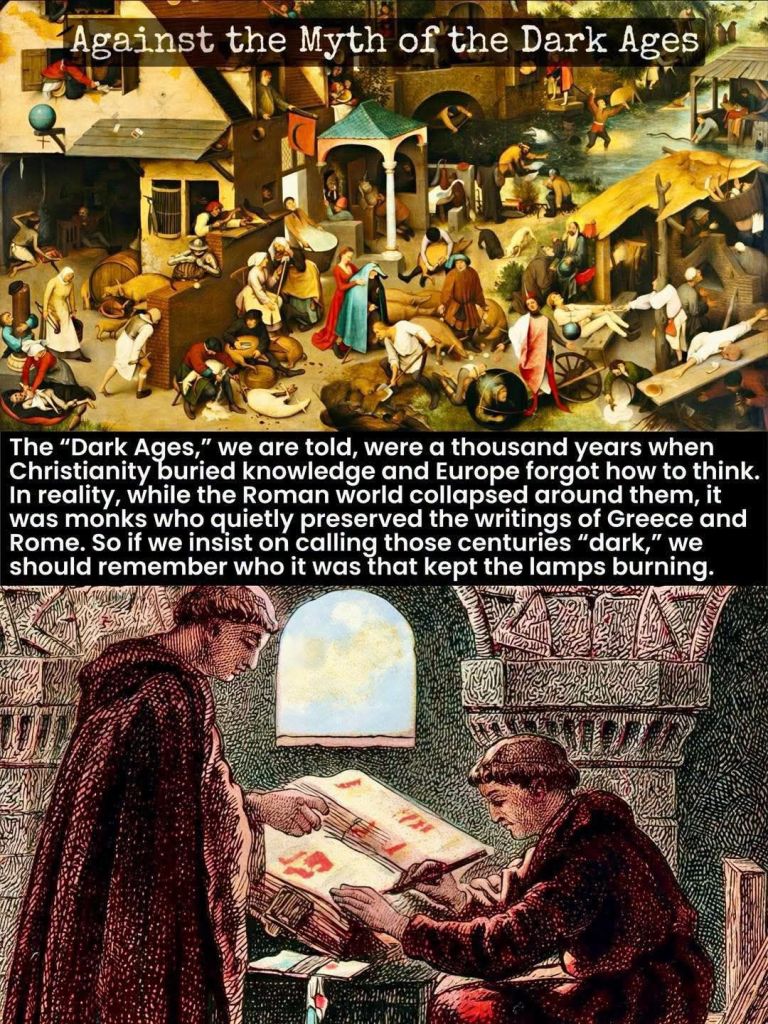
The phrase is repeated so often it has hardened into certainty. The Dark Ages, we are told, began when the Roman Empire collapsed and Christianity smothered the light of classical civilization. Science vanished. Learning died. Europe stumbled blindly through a thousand years of superstition until the Renaissance finally rescued reason from the grip of priests.

It is a tidy story. It is also wrong.

When the Western Roman Empire collapsed in the fifth century, the disaster was not theological—it was civilizational. Cities emptied. Trade routes collapsed. Roads crumbled. Literacy declined. Political authority fractured into a patchwork of Germanic kingdoms that possessed neither the administrative machinery nor the cultural inheritance of Rome.

The darkness that followed did not descend because monks burned books. It descended because the world that produced those books had collapsed.

And yet, in the wreckage of that fallen order, something remarkable happened. In lonely valleys and along forested hillsides, small communities of Christian monks began doing something that no conquering army, no new king, and no collapsing city seemed interested in doing: they preserved the memory of the ancient world.

Inside monastic scriptoria, by candlelight and patient discipline, monks copied manuscripts—line by line, page by page. They copied the Scriptures, of course. But they also copied Virgil, Cicero, Ovid, Livy, and countless other works of classical antiquity. Without those quiet labors, much of what we know about Greece and Rome might simply have vanished.

The men doing this work were not secular humanists ahead of their time. They were Christians. They believed that truth, wherever it appeared, ultimately belonged to God. Preserving learning was not rebellion against faith. It was an act of devotion.

Monasteries became islands of stability in a turbulent world. They cultivated fields, organized communities, and preserved literacy at a moment when most of Europe had forgotten how to read. Their libraries became reservoirs of memory while kingdoms rose and fell around them.

Over time those small islands of learning began to connect. By the eleventh and twelfth centuries a new intellectual revival was underway. Cathedral schools evolved into institutions dedicated entirely to scholarship. These institutions would soon receive a new name—universities.

The University of Bologna, Paris, and Oxford did not emerge in defiance of the Church. They were born inside it. Theology stood beside law, medicine, and philosophy as part of a unified search for truth. Scholars argued fiercely over Aristotle, debated logic, experimented with natural philosophy, and tried to reconcile reason with revelation.

The medieval world was not anti-intellectual. It was intensely intellectual. Figures like Thomas Aquinas, Albertus Magnus, and Roger Bacon wrestled with the newly rediscovered works of Aristotle and the expanding body of knowledge flowing from the Islamic world. They did not treat faith and reason as enemies. They believed both ultimately pointed toward the same reality.

Even the foundations of what would later become modern science were quietly forming during these centuries. Medieval thinkers developed the idea that nature operated according to rational laws because it had been created by a rational God. If the universe was ordered rather than chaotic, then studying it was not impiety—it was a form of worship.

The irony is striking. The very civilization accused of plunging Europe into darkness built the intellectual institutions that would eventually illuminate it.

None of this means the medieval world was idyllic. It was violent, unequal, and often brutal. Wars were frequent. Plagues were devastating. Superstition and ignorance certainly existed. But these were not the unique failings of Christianity. They were the universal conditions of premodern life.

What Christianity provided was something different: continuity.

While political power fractured and empires dissolved, the Church preserved a transnational network of literacy, scholarship, and moral authority that stretched across Europe. Monasteries safeguarded texts. Universities trained scholars. Cathedrals became centers of art, architecture, and education.

The world that later produced the Renaissance did not emerge from a thousand years of darkness. It emerged from a civilization that had spent centuries preserving the light.

History rarely fits into the neat morality plays modern culture prefers. The medieval centuries were neither a golden age nor a pit of ignorance. They were something far more interesting: a long and difficult bridge between the ancient world and the modern one. And if we insist on calling them “dark,” we should remember who it was that kept the lamps burning.

An Unholy Alliance

A spiritual battle is coming to the West, actually it is already here, and it is going to get worse and more deadly if the Church fails to rise up and take a stand.  The enemies are Wokism and Marxism combining with Islam to go after and destroy the American way of life.

Pray for the Persecuted Church

Millions of Christians face persecution, violence, and extreme poverty because of their faith.

Today we pray for the persecuted Church.

aclj.pulse.ly/grgjzm2sjt

Freedom vs Communists


Pastorwardclinton.com
Only in America do you find a kid wearing $150+ tennis shoes, drinking a $5 cup of “coffee,” while typing on his $1,000 cell phone and complaining on social media that he is oppressed and that capitalism has failed him.

The battle isn’t really between nations, it may appear that way but it is really between good and evil. We are already engaged in that battle and the U.S., in a very bold move by the left, has shifted towards normalizing evil!

The Deep State Democrats are currently waging a cultural revolution in America.  Their end goal is Marxism.  And, yes, Creepy Joe is one of them.

If God has abandoned America, the last shining light on the hill, then these are the end times and there is literally nothing we can do to stop the evil that is coming. If God has not abandoned America, then it is our job and responsibility as believers to do everything we can to fight to win America back.

Every Christian in America needs to be praying that God will send His Holy Spirit and His angels to expose all of the evil in America and bring genuine justice back to America.

So, which is it?

Choose your course wisely because God has given you control of your own destiny as well as the ability to affect the destiny of others.

Candace in April 2024

Just a reminder of what she was saying then.  A very accurate statement.

America’s Christian Roots

U.S. Supreme Court stated in the 1892 case of Church of the Holy Trinity v. United States, written by Justice David Josiah Brewer (143 U.S. 457-458, 465-471, 36 L ed 226):  ” This is a religious people.

This is historically true. From the discovery of this continent to the present hour, there is a single voice making this affirmation.

The commission to Christopher Columbus…(recited) that

‘it is hoped that by God’s assistance some of the continents and islands in the ocean will be discovered’…

The first colonial grant made to Sir Walter Raleigh in 1584…and the grant authorizing him to enact statutes for the government of the proposed colony provided

‘that they be not against the true Christian faith’…

The first charter of Virginia, granted by King James I in 1606…commenced the grant in these words:

‘…in propagating of Christian Religion to such People as yet live in Darkness…’

Language of similar import may be found in the subsequent charters of that colony…in 1609 and 1611; and the same is true of the various charters granted to the other colonies.

In language more or less emphatic is the establishment of the Christian religion declared to be one of the purposes of the grant.

The celebratedcompact made by the Pilgrims in theMayflower , 1620, recites:

‘Having undertaken for the Glory of God, and advancement of the Christian faith…a voyage to plant the first colony in the northern parts of Virginia’…

– Pastor Ward Clinton

Happy blogging!

14 year old Confronts Perverts on School Board

https://x.com/i/status/2068368511668285832

Were the Founding Fathers Deist?

Even the four that are recognized as Deists, used scripture in their personal writings which is well documented.  The only reason they are they are even considered Deists is due to the fact those 4 did not belong or declare a specific religious church.  But all them were well educated in scripture.

Thomas Jefferson later in life was part of a Baptist Bible study group and taught calvanist theology.

Benjamin Franklin called the Continental Congress to pray, which makes the claim that he was a deist rather questionable.

Christian Values

This really sums it up.

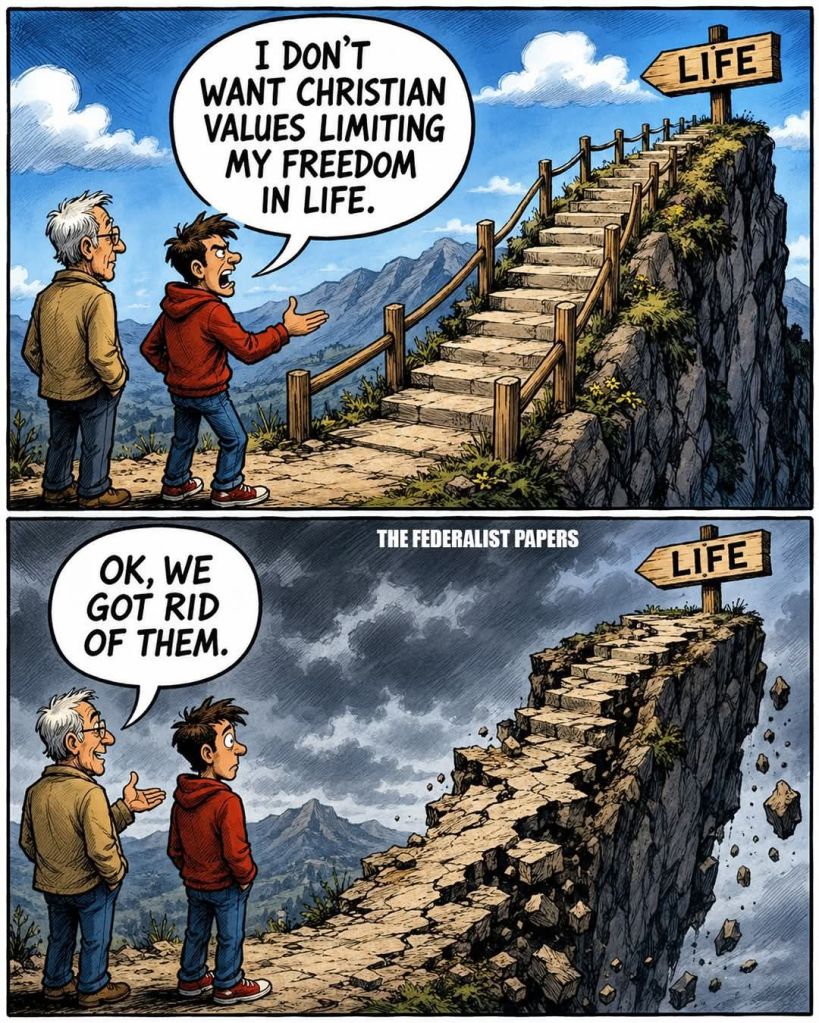
For years, we have been told that Christian values are the problem. They are too restrictive, too old fashioned, too judgmental, too limiting. The message has been drilled into the culture over and over again, freedom means removing every moral boundary, every inherited standard, and every inconvenient truth.

But the cartoon gets to the heart of the issue.

“I don’t want Christian values limiting my freedom in life.”

Then comes the answer.

“Ok, we got rid of them.”

And suddenly the path to “life” is broken, crumbling, and dangerous.

That is the part so many people miss. Christian values were never meant to be a prison. They were guardrails. They were the foundation that helped build strong families, honest communities, personal responsibility, respect for life, respect for marriage, respect for children, and respect for something bigger than the self.

Take those away, and you do not get some enlightened utopia.

You get confusion.

You get broken homes.

You get people chasing freedom while becoming slaves to impulse, ideology, government dependency, and cultural insanity.

The left has spent decades mocking the very values that held society together, then acts shocked when the results show up in the streets, schools, courts, and homes.

They wanted a culture without judgment, then wondered why standards disappeared.

They wanted freedom without responsibility, then wondered why chaos followed.

They wanted life without the values that protect life, then wondered why everything started falling apart.

That does not mean every Christian is perfect. It does not mean every church has always gotten everything right. But it does mean the basic moral framework that shaped this country mattered far more than our elites ever wanted to admit.

Maybe the “limits” were not the problem.

Maybe they were the only thing keeping the road from collapsing.

Great Awakening needed

It was intended from the very foundation that the US of A would be a Christian nation.  Our laws, from the outset, were based on the Holy Bible and perusals of the founders’ writings prove that to be a fact, much to the ACLU’s dismay, not to mention Freedom From Religion and other antichristian organizations.  Furthermore, it is only persons of high moral fiber who are supposed ot be permitted to be in positions of “public service” according to the founders.  It is not the (Anthony) Wieners and (Barney) Franks and the citizens are supposed to be watching and dictating to the government what its limits are while holding the politicians accountable for their actions.  Unfortunately, too many citizens have abdicated their watchdog responsibility and allowed amoral, even immoral, hotdogs to sneak in to those positions of power.  It is time to get busy and clean out all the slime from Washington, D.C.  We have the internet, for now, where we can bypass the biased media to get the word out and mobilizing.

“There has been a systematic attempt to mislead Christians by disinformation generated by anti-Christian writers who have obscured or denied the Christian nature of our heritage and civil government and law.” (Archie P. Jones, Ph.D., Foreword to Benjamin F. Morris’ The Christian Life and Character of the Civil Institutions of the United States, 1864, reprint 2007 by American Vision, Inc)  Back at the foundation of this nation, America, the people understood the lessons from the Holy Bible that civil government is used by God to work out His holy will in the lives of men and nations.

“Our forefathers in the faith did not retreat from involvement in society and politics.  They did not turn civil government, the making and enforcement, and adjudication of laws, over to Satan and those who serve him.” (Jones)  It was Christianity, not paganism or secularism which produced freedom and justice in the west and in America, it certainly wasn’t Islam.  “’There is nothing,’ says Webster, ‘we look for with more certainty than this principle, that Christianity is a part of the law of the land.  Everything declares this.  The generations which have gone before speak to it, and pronounce it from the tomb.’” (Morris, p 245)  “The statesmen of the Continental Congress, in their deliberations, officially recognized the Christian religion, and incorporated its principles into their legislative acts.” (Morris, p 245)

John Adams, in a letter to his wife describes the scene of the 1st Continental Congress “When the Congress first met, Mr. Cushing first made a motion that it should be opened with prayer.” (Morris, p246)  It was a non-sectarian, yet decidedly Christian, prayer which ended with “we ask in the name and through the merits of Jesus Christ, thy Son, our Savior. Amen!” (Morris, pp 249-250)  “The state papers of the Continental Congress were also full of the spirit and sentiments of the Christian system,” (Morris, p 46).  We have a great and Godly heritage in spite of what the ACLU and others of an anti-Christian mindset wish to profess and the documents are once again being brought out to the light of day for our studious perusal at this crucial point in time.  Crucial, because we most definitely need a new awakening similar to that which brought the United States into existence.

We desperately need a Great Awakening in this country and 2nd Chronicles 7:14 provides the recipe for it.

–Pastor Ward Clinton